

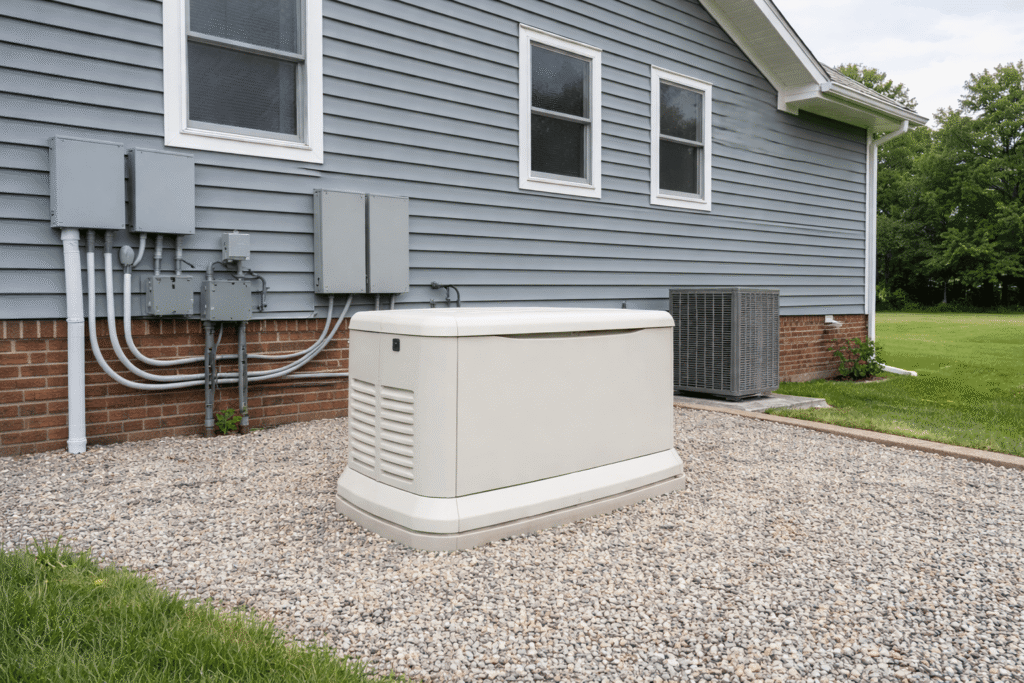
How to size a generator for your home depends on total electrical load, not square footage.
How to Size a Generator for Your Home: Understanding Your Power Needs
The first step in sizing a generator is understanding your home’s power requirements. This involves calculating the wattage needed to power essential appliances and systems.
Identify Essential Appliances
Not every appliance needs to be powered during an outage. Focus on essentials such as:
- Refrigerator and freezer
- Heating or air conditioning systems
- Water heater
- Sump pump
- Lighting circuits
- Medical equipment
- Certain kitchen appliances like the microwave
Calculate Total Wattage
For each appliance, determine its starting (surge) and running wattage. For formal guidance on electrical load calculations, you can review general load calculation guidelines from the U.S. Department of Energy. You can typically find this information on the appliance’s data plate or manual. Use the following table as a reference to estimate the typical wattage requirements for common household appliances:
| Appliance | Starting (Surge) Wattage | Running Wattage |
|---|---|---|
| Refrigerator/Freezer | 2,200 W | 700 W |
| Electric Water Heater | 4,500 W | 4,500 W |
| Central Air Conditioner | 5,000 W | 3,500 W |
| Sump Pump | 2,150 W | 1,050 W |
| Microwave | 1,500 W | 1,500 W |
| Lights (10 bulbs) | 600 W | 600 W |
Add up the running wattages of all the essentials and then add the highest starting wattage of any appliance to get the total wattage requirement.
Considering a Safety Buffer
It’s prudent to incorporate a 15–20 percent safety buffer into your total wattage calculation. This buffer accounts for any unforeseen increases in power demand or additional appliances you might need to run at the same time. To apply the buffer, multiply your total wattage by 1.15 or 1.20.
For example, if your calculated power requirement is 10,000 W, include a buffer by calculating: 10,000 W x 1.20 = 12,000 W. This means you should look for a generator capable of providing around 12,000 W.
Types of Home Generators
Knowing your power needs helps in deciding the type of generator suitable for your home. Here are the main types:
Portable Generators
These are versatile units that can be moved around and are ideal for temporary power needs. They are generally less expensive but require manual operation and fueling. Portable generators typically provide between 3,000 and 8,000 watts.
Standby Generators
Standby generators are permanently installed outside your home and connect directly to your home’s electrical system via an automatic transfer switch. They offer more power than portable generators, usually ranging from 7,000 to 20,000 watts or more, and are a reliable choice for longer outages.
Real U.S. Examples
To put generator sizing into perspective, consider these U.S. homeowners:
- Jane from Florida uses a portable generator for hurricane outages. Her home needs 7,500 W, so she chose a 9,000 W generator to accommodate future needs and added a buffer.
- Mark in Ohio installed a standby generator. With requirements totaling 17,000 W, he opted for a 20,000 W generator to comfortably power his entire household system, including heating during winter storms.
- Susan from California primarily experiences rolling blackouts. Her needs amount to 5,000 W, so she uses a 6,000 W portable generator for short-term electricity but plans to upgrade to a standby system.
Additional Factors to Consider
While wattage is key, other factors will influence your generator choice:
Fuel Type
Generators are powered by gasoline, propane, natural gas, or diesel. Consider availability and storage requirements. Standby generators often use natural gas or propane, providing the benefit of continuous operation without the need for refueling.
Climate and Weather
Your geographic location affects your generator needs. In colder climates, additional power might be necessary for heating equipment. Likewise, hot areas may need extra power for air conditioning.
Budget Constraints
Cost is always an essential factor. Portable generators are cheaper upfront, while standby generators require higher initial investment but provide increased reliability. Consider long-term costs including fuel consumption and maintenance.
FAQs
What is the difference between starting watts and running watts?
Starting watts are the additional watts needed for 2-3 seconds to start motor-driven products such as a refrigerator or freezer. Running watts are the continuous watts needed to keep items running.
Can I run my entire house with a generator?
It depends on your home’s total power requirement and the generator’s capacity. For complete home coverage, including HVAC systems, a larger standby generator is typically recommended.
Do generators require regular maintenance?
Yes, regular maintenance, including oil changes, filter replacements, and performance checks, is crucial for the longevity and efficiency of your generator.
Is it legal to install my own standby generator?
Installation requirements vary by location. Many areas require permits and professional installation to ensure safety and compliance with local codes.
How long can a generator run continuously?
This depends on the generator type and fuel capacity. Portable generators typically run 8-12 hours on a full tank, while standby generators can run continuously as long as they have a fuel supply.
Are there safety concerns with generator use?
Yes, generators produce carbon monoxide, so they must be used outdoors and well-ventilated. Proper grounding and maintenance also help prevent electrical hazards.
Conclusion
Properly sizing a generator for your home involves understanding your power needs, considering a safety buffer, and choosing the right type of generator for your circumstances. By taking these steps, you can ensure that you’re prepared for any power outage, providing peace of mind and security for your family. Evaluate your needs carefully, and consult with professionals if necessary, to make the best-informed choice for your home.